London’s Future: The Global Stage for Flagship Retail
London and New York lead by flagship presence

Across 30 of the world’s leading* mass market and premium fashion brands by revenue and consumer market size, each has a flagship** in both London and New York.
*Fashion, footwear, athleisure, and closely related fashion accessories brands selected based on a combination of global revenue, international presence, brand recognition, and current market relevance.
**Brand’s primary or lead retail location in that city – prime location, large format, brand showcase, immersive/experiential design, extensive inventory.
Figure 4: Flagship presence of leading 30 mass market/premium brands in each city
London
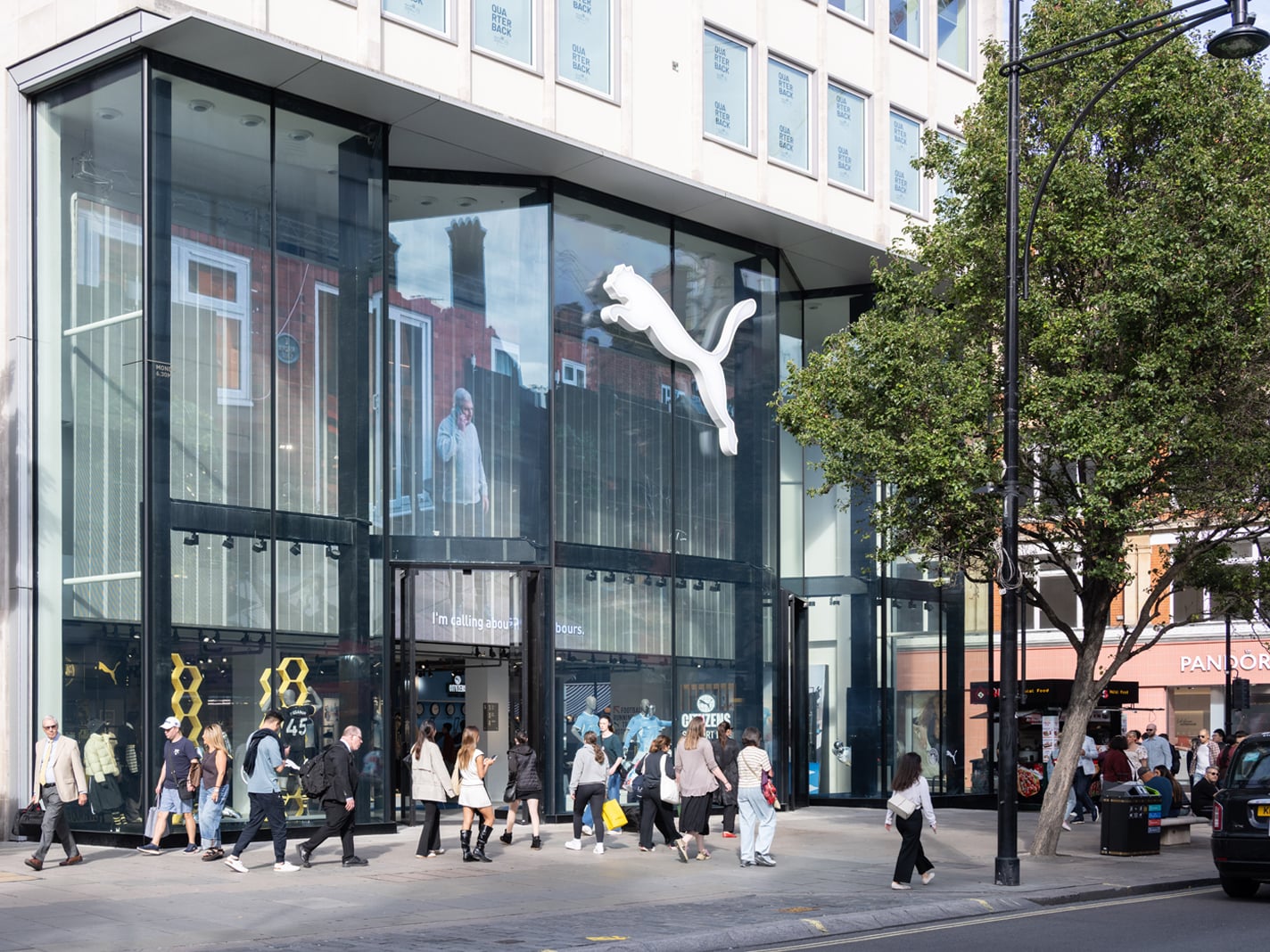
Out of the 30 brands, several operate their largest global or European store in London. Additionally, more than half of the sample have their flagships located on Oxford Street. In 2025, PUMA opened its flagship on Oxford Street which spans 24,000 sq ft across three floors and features immersive zones including customisation areas, latest innovations, exclusive collections, and a programme of events and activations. Similarly, New Balance’s Oxford Street store spans 13,600 sq ft across three floors and has a dedicated basement space for the premium ‘Made in UK’ collection.
After Oxford Street, Regent Street houses 40% of the brands’ flagship stores. Many brands select Regent Street for their first standalone stores including COS in 2007 and & Other Stories in 2013 (both part of the H&M group) alongside new entrants due to its position as a street with premium credibility and mass market footfall.
Growth Markets
Miami, Riyadh, and Mumbai trail the sample at 47%, 37%, and 33%, respectively. Riyadh’s Vision 2030-driven retail investment has already brought brands including On, lululemon, and Hugo Boss into prime mall locations, and the pipeline of both retail development and international brand entry suggests the count will look different within five years. In Mumbai, a strong influx of high-quality retail development including Oberoi Sky City Mall (1.3 million sq ft), Borivali in 2025, and the luxury mall Jio World Plaza, BKC in 2023, has strengthened its organised retail landscape and supported the entry of several international brands across sectors.
Mature Markets
New York has the highest number of global flagship stores among the brands in the sample, with 70% located on Fifth Avenue. For example, Adidas operates flagships in all 15 cities, with its largest global store on Fifth Avenue in Manhattan spanning 45,000 sq ft across four floors, including a stadium stand, nutrition bar, and customisation zone. On, despite only entering physical retail at scale over the last few years, has confirmed flagships in 12 of the 15 cities. The brand chose New York for its first global flagship, on Lafayette Street in the NoHo neighbourhood, and now operates its largest store on Fifth Avenue.
Shanghai, Paris, Tokyo, and Amsterdam attract most of the sample brands, reflecting the depth and maturity of the prime retail districts. The Champs-Elysées alone hosts many major flagships and is one of the most brand-dense flagship streets in continental Europe. In Amsterdam, demand for prime flagship locations remains structurally strong, particularly on Kalverstraat. Abercrombie returned in 2026 after vacating an earlier store in 2022. However, premium brands with stores in a selective number of key international cities are also expanding in locations such as De 9 Straatjes (lululemon) and Van Baerlestraat.
Seoul at 80% reflects rapid maturation as a global retail capital, with brands including Adidas, New Balance, and H&M having opened their flagship stores in the city within the last three years.
London serves as a gateway for leading international emerging brands
H1 2026 new Central London requirements:
Canada
- GarageOxford Street, 2025
- MejuriMarylebone, 2021
US
- Peter MillarNew Bond Street, opening 2027
- SKIMSRegent Street, 2026
- EdiktedCarnaby Street, 2026
- AmiriNew Bond Street, 2026
- KITHRegent Street, 2025
- FanaticsRegent Street, 2025
- Alo YogaKing’s Road, 2023
- HOKAJames Street, 2023
- PaigeKing’s Road, 2023
- VuoriCovent Garden, 2022
- Aime Leon DoreSoho, 2022
- Alice + OliviaBruton Street, 2022
- GlossierCovent Garden, 2021
- ReformationNotting Hill, 2019
Brazil
- Farm RioKing’s Road, 2023
Spain
- MaksuBruton Street, 2024
- FlabelusChelsea, 2023
- HOFFRegent Street, 2023
France
- BalzacMarylebone High Street, opening 2026
- Maison 123King’s Road, 2026
- PoleneRegent Street, 2024
- JacquemusNew Bond Street, 2024
- SézaneNotting Hill, 2018
Netherlands
- AurelienBrompton Road, 2026
- Mr MarvisKing’s Road, 2025
Switzerland
- ONRegent Street, 2023
Sweden
- AsketSoho, 2025
- TotemeMount Street, 2023
- Axel ArigatoSoho, 2016
China
- Urban RevivoCovent Garden, 2025
- Pop MartChinatown, 2022
Japan
- GoldwinSoho, 2026
Australia
- KookaiCarnaby Street, 2026
- Réalisation ParMount Street, 2024
- Grown AlchemistSoho, 2024
Note: Map shows international brands’ origin, where their first UK store was located and the year it opened
‘Emerging brands’: high-growth consumer retailers in the scale-up phase – having demonstrated commercial success in their home market and now deploying physical stores to accelerate growth
London stores function as marketing assets for emerging brands

For emerging or digital-first brands, the first physical store is an important strategic decision. These brands are seeking retail space for the wide-ranging benefits a store brings for brand identity, recognition, and building consumer loyalty, beyond physical sales alone.
Online customer acquisition costs have risen, and popularity has become largely driven by social media algorithms and influencer power, as highlighted in the results from our Retail Generational Survey. Social influence is now embedded in the customer journey; however digital and physical channels must work seamlessly together as consumers, particularly the younger generation, prefer shopping in-store over online.
Retail stores can function as marketing assets by raising brand awareness. Figure 5 shows recent London new entrants and UK search demand, with each store opening producing a clear spike in online search volumes. For KOOKAÏ, KITH, and Garage, this was their highest point of the period, and for Edikted, it was the highest since Black Friday.
This is driven by press attention and social media coverage generated by the location, with an increasing number of people visiting stores for content creation opportunities. Search demand holds after opening. The four London flagships average 38% higher weekly search interest in the 13 weeks after launch than the 13 weeks before. KITH, with nine months of post-opening data, holds 35% above the matched pre-opening average.
Additionally, consumers can see, touch, and test the product which build brand loyalty, and omnichannel fulfilment services create a seamless consumer journey, strengthening the store’s role within the wider fulfilment network. This is why site selection is even more important for emerging brands as it is their first physical brand touchpoint.
As the store has become a marketing and brand asset rather than simply a point of sale, the logic of where to place it changes too. Early locations are chosen for visibility, cultural signal, and audience, and that concentrates demand in a small number of global gateway cities, including London. Also, many brands will opt for concessions in department stores such as Selfridges in London, which serves as a testbed for a standalone store.
Figure 5: Recent London new entrants’ openings and UK Google Search demand
Note: Numbers represent search interest relative to the highest point on the chart for the given region and time. A value of 100 is the peak popularity for the term. A value of 50 means that the term is half as popular. A score of 0 means there was not enough data for this term.

The four London flagships average 38% higher weekly search interest in the 13 weeks after launch than the 13 weeks before. KITH, with nine months of post-opening data, holds 35% above the matched pre-opening average.
London as a launchpad for UK-founded brands

London’s flagship pull runs both ways; international brands choose London to arrive, and the UK’s own brands use London as the launchpad to global expansion. For many UK brands, a London flagship is not the culmination of an expansive domestic rollout, but the proof-of-concept for going global.
A flagship in a prime London location validates a brand at scale, generates the credibility and visibility that underpin international demand, and lifts online sales and awareness beyond the UK. For a British brand with global ambitions, establishing the home flagship in a city with global reach is the most efficient first step toward an international store network.
New York is often the first choice for British brands expanding due to the large consumer market, cultural ties, and shared language. Rixo picked New York in 2024, first as a three-month pop-up and then permanently, due to the US being its second-largest and fastest growing market. During the opening period, the pop-up generated a 43% increase in direct US sales across the store and e-commerce.
UK-founded brands’ first London stores and order of global expansion
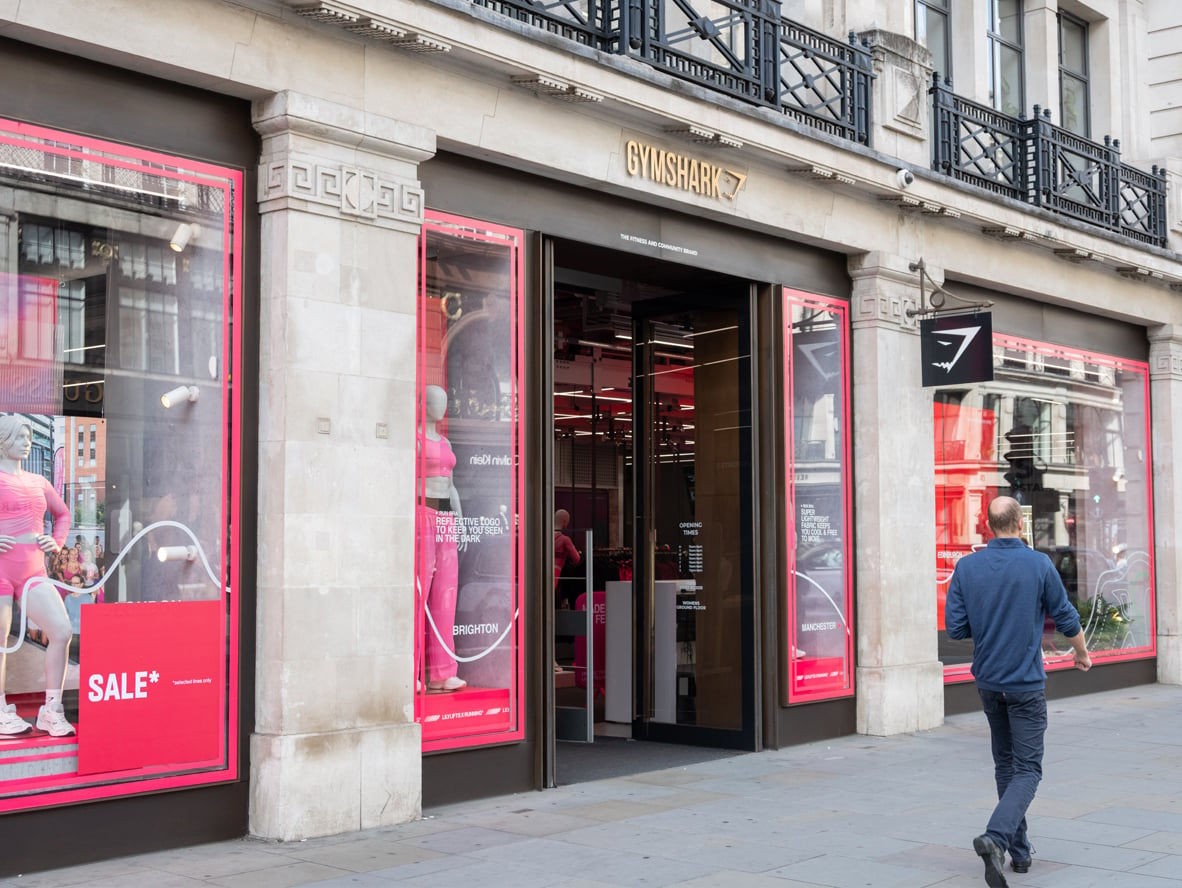
GYMSHARK
> Dubai Mall
> Amsterdam Kalverstraat
> NYC Roosevelt Field & Bond Street
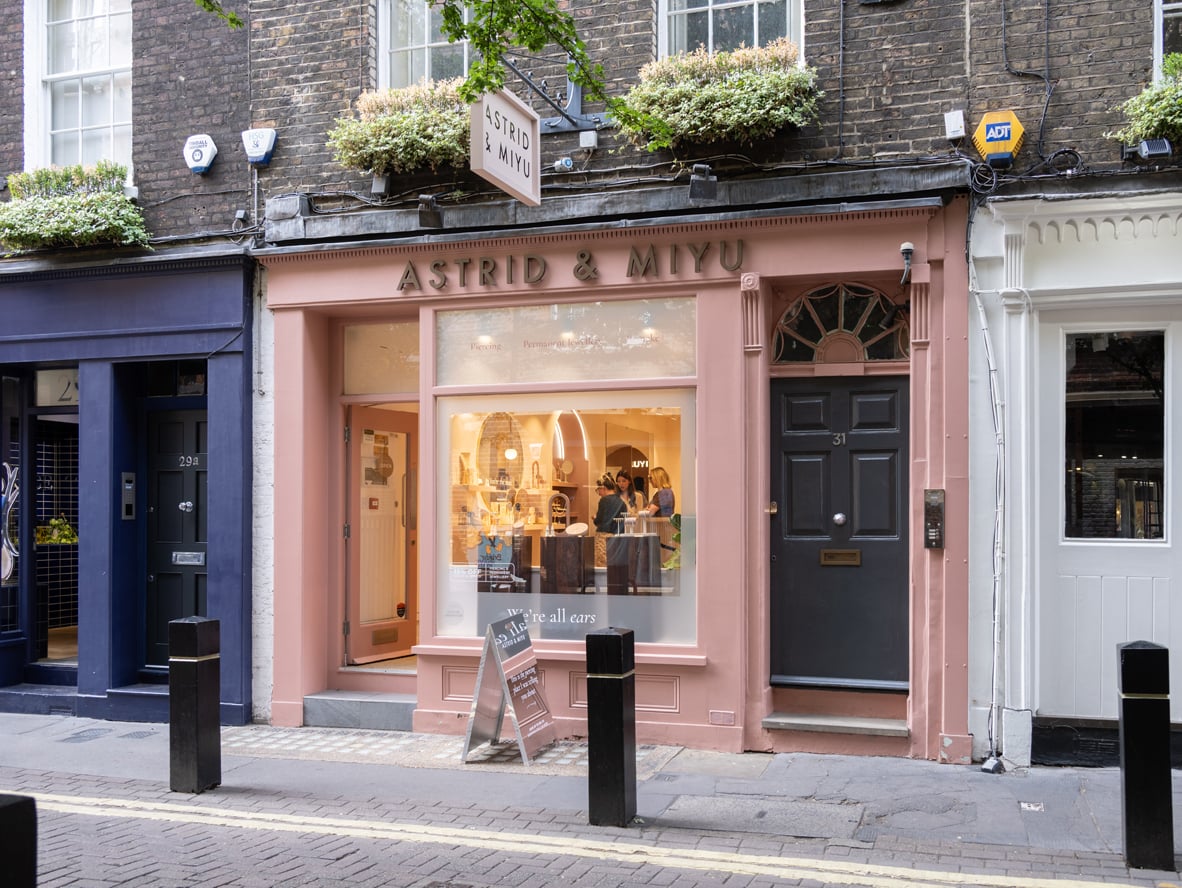
ASTRID & MIYU
> NYC Nolita
> c.30 US/EU stores
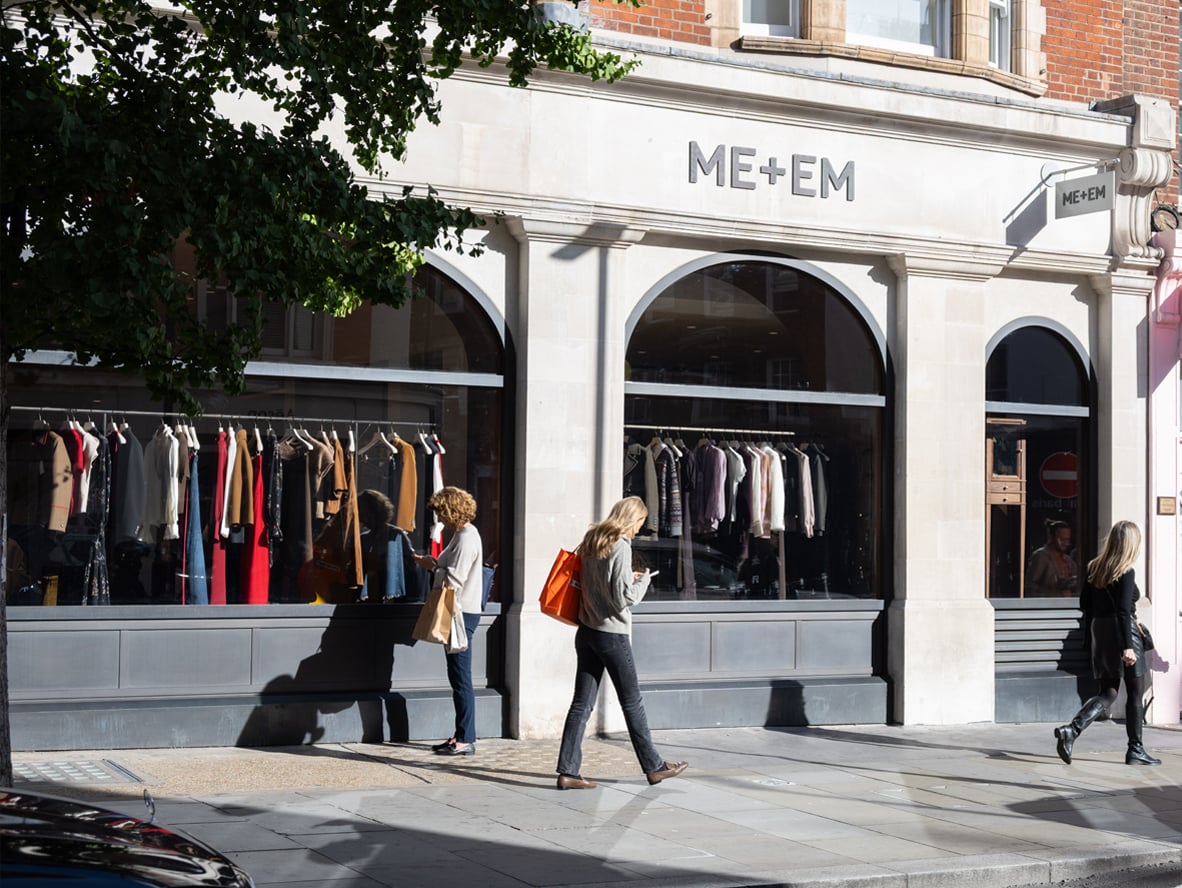
ME+EM
> NYC Madison Avenue
> Wider US expansion
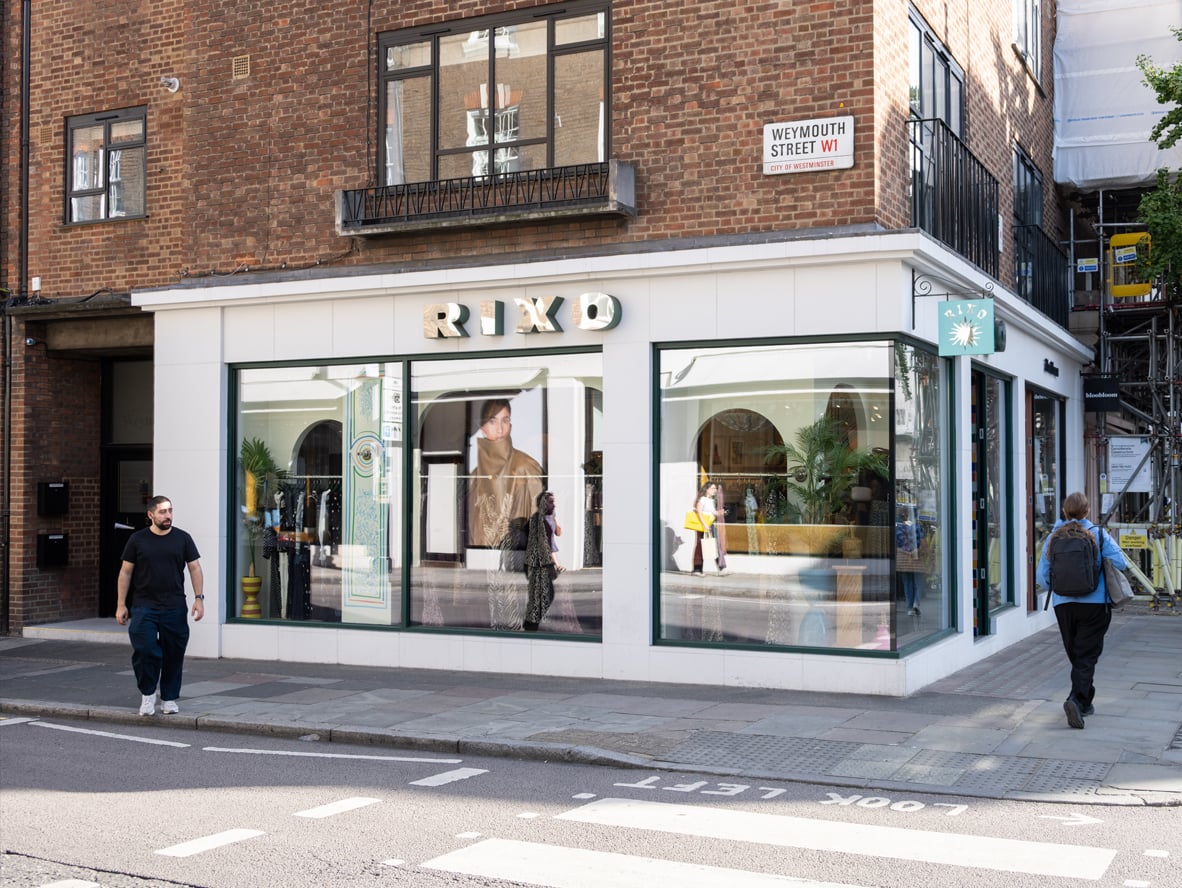
RIXO
> NYC Nolita
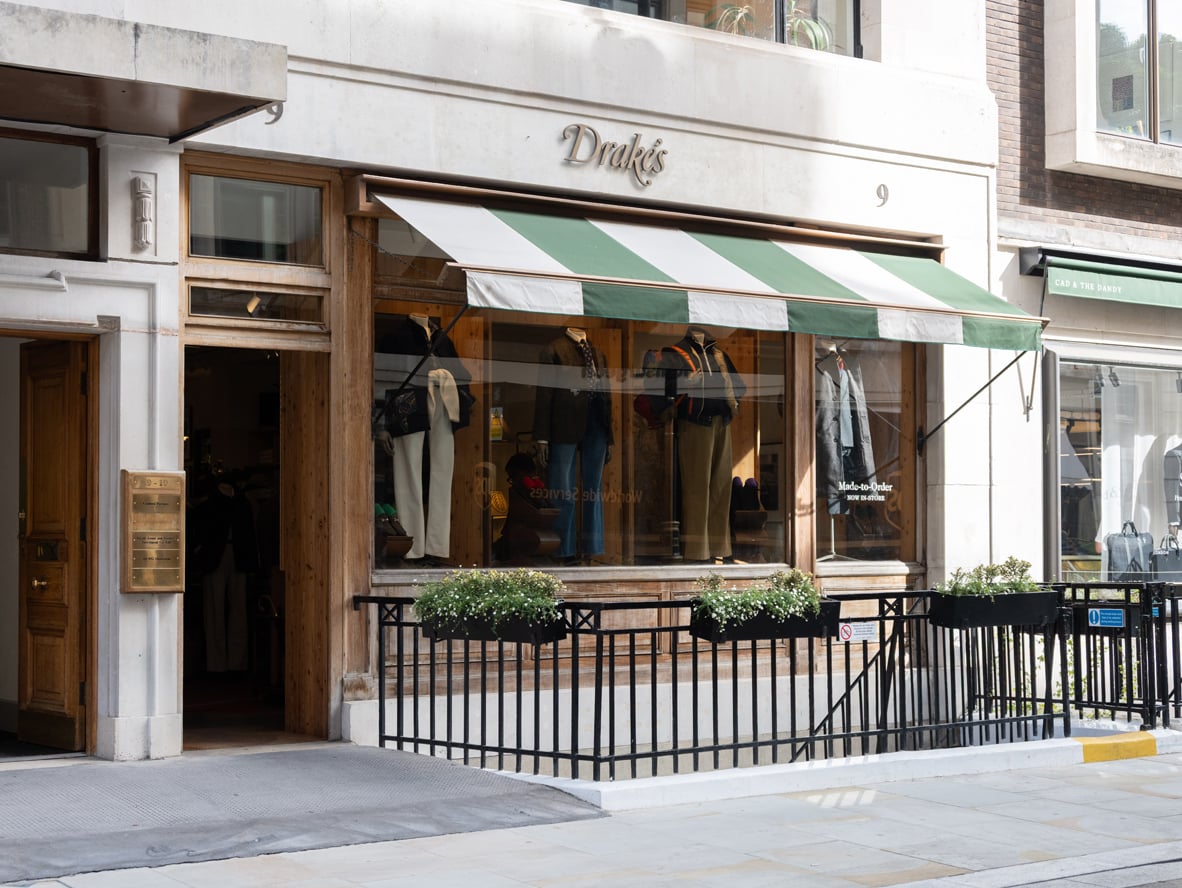
DRAKE’S
> NYC SoHo
> Seoul Dosan
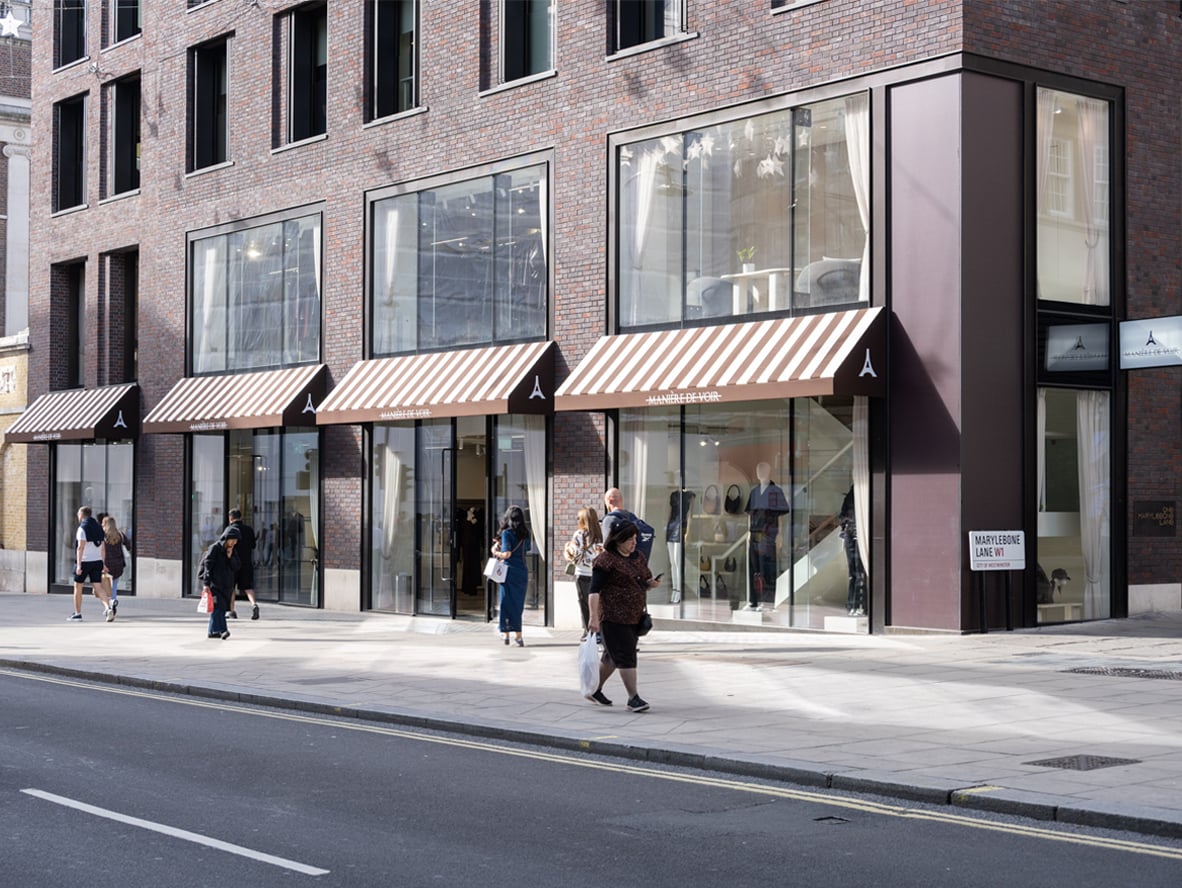
MANIÈRE DE VOIR
> NYC SoHo
> Dubai Mall
London is a core location for luxury flagship investment

Unlike mass market brands, which can have more flexibility in their location strategy, luxury brands seek long-term relationships with an area and are reluctant to consider other options.
Securing a presence on one of the world’s premier luxury streets is a global statement of brand success. Retailers want to capture affluent footfall, elevate brand status, and occupy large, architecturally significant space that enables immersive experiences. The scarcity of available space drives demand further, which has also resulted in luxury retail groups becoming active in purchasing stores occupied by their brands. An own-to-occupy strategy can take decades to secure the right store, with some retailers buying buildings while another tenant still occupies them, positioning to take over once the lease ends.
London’s luxury market has faced recent headwinds; however, brands are still committing and showing confidence in London. It is renowned for its prestigious neighbourhoods, hotel establishments, and cultural venues which continue to attract high-spending tourists alongside a strong local affluent population. Though London is experiencing a ‘wealth flight’ due to changes in government policy, London still has the most centi-millionaires and millionaires in Europe and is home to more than 7,800 ultra-high-net-worth individuals (UHNWIs).
This is vital for the luxury market as while UHNWIs make up just 2-4% of the luxury client base, they contribute at least 30-40% of market spending, according to Walpole.
While there are scaling markets such as Dubai, Seoul, Riyadh, and Mumbai, London remains a top core market, and luxury brands have sustained desire for a long-standing presence here.
Key metrics supporting London luxury retail market

Local affluence
- No. 1 European city for centi-millionaires (352) and millionaires (215,700)
- The UK is expected to see the highest absolute growth ($2.4tn) in household wealth (including property and pensions) to 2029 compared to other major European markets (Oxford Economics)


Fashion talent and education
- London is home to three of the top 10 fashion schools in the world, more than any other city

Retail investment
- 25% of all European high street investment since 2022 has been in London, ranking No. 1 in 2022, 2023, and 2025. This has been concentrated on Bond Street (CBRE Research)



Luxury health & wellness
- Over 3,000 specialists working in private medicine on and around Harley Street and a concentration of luxury wellness clubs in London such as the Lanserhof at The Arts Club on Dover Street and Surrenne at the Emory
Global luxury flagship presence

We analysed the top 10 leading global luxury brands and their presence across 15 global cities shown in Figure 6, alongside each city’s local affluence in terms of the number of millionaires and centi-millionaires.
In our sample, London ranks fifth on store count and millionaires, and third globally on centi-millionaires behind only New York and Los Angeles, with more than 350 individuals holding assets of $100m or more. International visitor demand also widens that base significantly, as explored earlier in the report, London is the most visited city in the sample and top overall European city drawing major international spend from visitors from China and the Gulf countries.
This strong and resilient consumer base profile supports London’s luxury retail market and concentrated sales densities. London’s luxury flagship stores are situated almost entirely on two streets – Bond Street and Sloane Street – some of the most sought-after stretches of retail real estate in the world.

Store format follows the same logic with brands typically occupying larger, more experiential formats on the higher footfall thoroughfares and more intimate boutiques on the more local streets. Burberry, the only British-founded brand in our top 10, occupies its largest global flagship on Regent Street at 44,000 sq ft (significantly larger than the typical footprints available on Bond Street or Sloane Street) and maintains further stores on both streets, reflecting London’s importance as its home market.
Figure 6: Count of standalone boutiques of the leading 10 global luxury brands and millionaires and centi-millionaires in each city
Methodology: Own-operated mono-brand boutiques in the city core. Excludes department store concessions (Harrods, Selfridges, Saks etc), airport stores, beauty-only counters, suburban.
London luxury flagship investment

London consistently sees luxury retail brands invest heavily in their flagship stores, with over £400m invested in the last 2 years, acknowledging their global significance.
This is achieved through innovative design, store format, excellent customer service, and offering exclusive experiences. Brands are investing in their current stores, relocating to more appealing units, as well as international retailers selecting London as one of their core flagship locations.
As previously mentioned, Bond Street and Sloane Street remain the centre of luxury flagships. More than 40% of Bond Street is owned by a retailer or their dynasty, underpinned by a desire to secure a long-term presence in a location with limited supply and growing rents. On Sloane Street, long-standing tenants have committed to the street through relocations and upsizing, facilitated through estate ownership which allows for strategic tenant moves. Emerging or independent luxury retailers are also focused on other locations, such as Mount Street and the wider Mayfair area, alongside London villages.
One of the largest investments is The Lazari Building at the former Fenwick store on New Bond Street. The development will be home to 35,800 sq ft of flagship retail space over the ground and first floors set to be delivered in 2027.
A trend during ongoing redevelopment is using the scaffolding as a brand opportunity and visual attraction. For example, Lazari has covered the development in Emerging Forms, an artwork installation by Hugo Dalton, a British artist. Other recent examples include on Fifth Avenue where Prada concealed renovation by covering the building in a green mesh-wrapped installation, and Louis Vuitton covering the façade with a branded stack of luggage trunks.
Quantifying London luxury flagship fit-out investment
To quantify the volume of recent investment into luxury flagship stores in London, we analysed store investment (new openings and refurbishments) on Bond Street and Sloane Street since 2025 using Turner & Townsend’s average luxury store fit-out costs*.
Luxury store fit-outs incorporate bespoke architectural finishes, high-end shopfitting, specialist joinery, cabinetry, and millwork designed to create a distinctive brand environment and customer experience. CBRE estimates £400m has been invested in luxury flagship retail fit-outs on Bond and Sloane Street since 2025 This results in significantly higher costs than standard retail fit-out costs.
Costs vary depending on brand positioning, degree of bespoke manufacture, premium material selection, and specialist craftsmanship requirements. For example, luxury jewellery and watch flagships typically carry the highest costs due to bespoke display cabinetry, security, specialist lighting, and premium materials. This is followed by leather goods and accessories, designer apparel, and luxury footwear.
Using a benchmark average fit-out cost from high-end luxury retail clients, we found that an estimated £400m has been invested*. This highlights confidence from both landlords and occupiers in the future of London’s luxury retail.

CBRE estimates £400m has been invested in luxury flagship retail fit-outs on Bond and Sloane Street since 2025
Read the next chapter: Limited vacancy across global flagship destinations
Continue reading to see how low vacancy on prime streets reflects strong flagship demand in London and other global cities.
Read the next chapter: Limited vacancy across global flagship destinationsWant to download the full report?
Business Contacts
Richard Smart
Managing Director, Head of London Markets

Phil Cann
Executive Director, Head of London Retail Investment

Peter Flint
Senior Director, Central London Retail


Research Contacts


Related Services
- Property Type
Retail
Delivering solutions to retailers, investors, owners, and developers. Our scale and coverage allow us to provide insight to all retail challenges.
- Retail
Central London Retail
Specialising in Central London retail, our team can help you maximise your retail portfolio through insightful and effective strategies.
- Retail
Retail Investment
Maximising the value of your property assets with our client-centred approach, providing unrivalled retail investment advice across global markets.
- Retail
Occupier Retail Services
Catering for properties and developments of all sizes, advising you on high street, shopping centres and supermarkets.
We’re perfectly placed to provide strategic advice on your cross-border retail and transaction services.
Providing market leading leasing and lease advisory services, ensuring your retail portfolio is working at maximum capacity.
- Retail
Out of Town Retail
We deliver market leading services throughout the UK for domestic and international clients, on retail parks, solus retail warehousing and foodstores.
Providing data driven insights for retail property owners at every stage of the asset life cycle.
- Valuation & Advisory Services
Retail Valuation Services
We have the industry's largest specialist Valuation team, providing unrivaled experience in valuing each retail sector.

Find Retail Property for Sale or Lease

Discover unique commercial retail properties across the UK. A portfolio of former branch properties are now available.

Easily find out-of-town retail properties available to rent in the UK with CBRE, the nation's largest commercial property solution provider.